Somalia has one of the lowest life expectancy rates in the region with an average on total population: 48.47 years; male: 46.71 years; female: 50.28 years (2006 est.). Somalia continues to have one of the highest child mortality rates in the world, with 10% of children dying at birth and 25% of those surviving birth dying before age five. The number is on total: 114.89 deaths/1,000 live births; male: 124.18 deaths/1,000 live births; female: 105.32 deaths/1,000 live births (2006 est.). But on the other hand Somalia also has one of the lowest HIV infection rates in Africa: 1% (2001 est.) or 43,000 (2001 est.) of people living with HIV. In education, with the collapse of the central government in 1991, the education system is now private. Quranic schools also known as duqsi's remain the basic system of instruction for religion in Somalia. They provide Islamic education for children, thereby filling a clear religious and social role in the country. The Qu'ranic system, which teaches the greatest number of students relative to the other education sub-sectors, is the only system accessible to nomadic Somalis compared to the urban Somalis who have easier access to education. In 1993, a survey by UNICEF was conducted in which it found, among other things, that about 40% of pupils in Qu'ranic schools were girls. The actual disparity against women in the Educational system in Somalia is even bigger in secular schools besides the problem of few higher-education schools. The country is also wrecked by many fatal diseases especially Malaria, killing 40% of all death.
GDP—per capita:
purchasing power parity - $550 (2001 est.)
Somalia’s estimated 6.8 million people live in extreme poverty and show some of the worst health indicators in the world. Somalis suffer from chronic food insecurity and severe droughts. More than 350,000 remain refugees, while 370,000 to 400,000 have been internally displaced often for years.
Sunday, April 1, 2007


Sunday, March 25, 2007
Who Pays America's Tax Burden, and Who Gets the Most Government Spending?, A Special Report
by Andrew Chamberlain, Gerald Prante and Scott A. Hodge
Special Report No. 151
Executive SummaryWhile many studies answer the question of who pays taxes in America, the question of who gets the most government spending is often overlooked. Just as some Americans bear a larger portion of the nation's tax burden than others, some Americans also receive a larger share of the nation's government spending.
This report summarizes the key findings of a comprehensive 2007 Tax Foundation study of federal, state and local taxes and government spending. The results show that when we consider the distribution of government spending as well as taxes, it provides a dramatically altered view of how U.S. fiscal policy affects Americans at different income levels than is apparent from the distribution of tax burdens alone.
Overall, we find that America's lowest-earning one-fifth of households received roughly $8.21 in government spending for each dollar of taxes paid in 2004. Households with middle-incomes received $1.30 per tax dollar, and America's highest-earning households received $0.41. Government spending targeted at the lowest-earning 60 percent of U.S. households is larger than what they paid in federal, state and local taxes. In 2004, between $1.03 trillion and $1.53 trillion was redistributed downward from the two highest income quintiles to the three lowest income quintiles through government taxes and spending policy.
These findings suggest tax distributions alone do not tell Americans how much the nation's fiscal system is helping or hurting low-income households. To answer that, we must look beyond tax burdens to government spending as well. Lawmakers who ignore the distribution of government spending risk making policy judgments based on an incorrect set of facts about the United States fiscal system.
Special Report No. 151
Executive SummaryWhile many studies answer the question of who pays taxes in America, the question of who gets the most government spending is often overlooked. Just as some Americans bear a larger portion of the nation's tax burden than others, some Americans also receive a larger share of the nation's government spending.
This report summarizes the key findings of a comprehensive 2007 Tax Foundation study of federal, state and local taxes and government spending. The results show that when we consider the distribution of government spending as well as taxes, it provides a dramatically altered view of how U.S. fiscal policy affects Americans at different income levels than is apparent from the distribution of tax burdens alone.
Overall, we find that America's lowest-earning one-fifth of households received roughly $8.21 in government spending for each dollar of taxes paid in 2004. Households with middle-incomes received $1.30 per tax dollar, and America's highest-earning households received $0.41. Government spending targeted at the lowest-earning 60 percent of U.S. households is larger than what they paid in federal, state and local taxes. In 2004, between $1.03 trillion and $1.53 trillion was redistributed downward from the two highest income quintiles to the three lowest income quintiles through government taxes and spending policy.
These findings suggest tax distributions alone do not tell Americans how much the nation's fiscal system is helping or hurting low-income households. To answer that, we must look beyond tax burdens to government spending as well. Lawmakers who ignore the distribution of government spending risk making policy judgments based on an incorrect set of facts about the United States fiscal system.
SOMALIA Week 9 updated
With a long history of Colonialization under the rule of the Britishs and the Italians, Somalia's political history is uniquely dependent on the systems of the Motherlands. Unstable for many decades, the Governments in Somalia has been in constant chaos and through many coups. Especially after Independence, Warlords have threatened to tear down the whole system. Nevertheless the current Transitional Government is expecting a more Democratic country in Somalia.
Colonial period
The year 1884 ended a long period of comparative peace. At the Berlin Conference of 1884, the Scramble for Africa started the long and bloody process of the imperial partition of Somali lands. The French, British and Italians came to Somalia in the late 19th century.
The British claimed British Somaliland as a protectorate in 1886 after the withdrawal of Egypt and the treaty with Warsangeli clan. Egypt sought to prevent European colonial expansion in Northeast Africa. The southern area, claimed by Italy in 1889, became known as Italian Somaliland. The northernmost stretch became part of the French Territory of Afars and Issas, also known as French Somaliland, until it later achieved independence as Djibouti.
The Somali War of Colonial Resistance (1898–1920) was led by Somali poet, scholar and statesman, Mohammed Abdullah Hassan. The war ended with the RAF's bombing of the Sayid's fort, with massive loss of civilian and military life on the Somali side.
Climate
Major climatic factors are a year-round hot climate, seasonal monsoon winds, and irregular rainfall with recurring droughts. Mean daily maximum temperatures range from 30°C to 40°C (85–105°F), except at higher elevations and along the east coast. Mean daily minimums usually vary from about 15°C to 30°C (60–85°F). The southwest monsoon, a sea breeze, makes the period from about May to October the mildest season at Mogadishu. The December-February period of the northeast monsoon is also relatively mild, although prevailing climatic conditions in Mogadishu are rarely pleasant. The "tangambili" periods that intervene between the two monsoons (October–November and March–May) are hot and humid.
Economy
Since the collapse of the state, Somalia has transformed from what Mohamed Siad Barre referred to as "scientific socialism" to a free market economy.
Due to the lack of government oversight or statistics, and the recent war, it is difficult to calculate the size or growth of the economy. For 1994, the CIA estimated GDP at $3.3 billion In 2001, it was estimated to be $4.1 billion. In 2005, the CIA estimated GDP to be $4.809 billion. Real growth in 2005 was projected at 2.4%.
Agriculture is the most important sector, with livestock accounting for about 40% of GDP and about 65% of export earnings. Nomads and semi-nomads, who are dependent upon livestock for their livelihood, make up a large portion of the population. After livestock, bananas are the principal export; sugar, sorghum, maize, and fish are products for the domestic market. The small industrial sector, based on the processing of agricultural products, accounts for 10% of GDP.
Population
Somalia has a population of around 10,700,000 according to UN estimations in 2003, 85% of which constitute ethnic Somalis.
There is little reliable statistical information on urbanisation in Somalia. However, rough estimates have been made indicating an Urbanisation of 5% and 8% per annum with many towns rapidly growing into cities. Currently, 34% of the Somali population lives in towns and cities with the percentage rapidly increasing.
Because of the civil war, the country has a large diaspora community, one of the largest of the whole continent. There are over a million Somalis outside of Africa, and this excludes those who have inhabited Ogaden province, northeastern Kenya, and Djibouti.
With the Economy relies too heavily on Agriculture, Somalia's exports are under heavy burden and disadvantages because of heavy taxes and subsidies in rich countries. Foreign debt is currently 2.56 billion dollars. Because of Refugee movements in response to food shortages and clan warfare, the UN estimates that 350,000 people were internally displaced by the civil war in 2001. About 450,000 Somalis are living in refugee camps outside the country.
Colonial period
The year 1884 ended a long period of comparative peace. At the Berlin Conference of 1884, the Scramble for Africa started the long and bloody process of the imperial partition of Somali lands. The French, British and Italians came to Somalia in the late 19th century.
The British claimed British Somaliland as a protectorate in 1886 after the withdrawal of Egypt and the treaty with Warsangeli clan. Egypt sought to prevent European colonial expansion in Northeast Africa. The southern area, claimed by Italy in 1889, became known as Italian Somaliland. The northernmost stretch became part of the French Territory of Afars and Issas, also known as French Somaliland, until it later achieved independence as Djibouti.
The Somali War of Colonial Resistance (1898–1920) was led by Somali poet, scholar and statesman, Mohammed Abdullah Hassan. The war ended with the RAF's bombing of the Sayid's fort, with massive loss of civilian and military life on the Somali side.
Climate
Major climatic factors are a year-round hot climate, seasonal monsoon winds, and irregular rainfall with recurring droughts. Mean daily maximum temperatures range from 30°C to 40°C (85–105°F), except at higher elevations and along the east coast. Mean daily minimums usually vary from about 15°C to 30°C (60–85°F). The southwest monsoon, a sea breeze, makes the period from about May to October the mildest season at Mogadishu. The December-February period of the northeast monsoon is also relatively mild, although prevailing climatic conditions in Mogadishu are rarely pleasant. The "tangambili" periods that intervene between the two monsoons (October–November and March–May) are hot and humid.
Economy
Since the collapse of the state, Somalia has transformed from what Mohamed Siad Barre referred to as "scientific socialism" to a free market economy.
Due to the lack of government oversight or statistics, and the recent war, it is difficult to calculate the size or growth of the economy. For 1994, the CIA estimated GDP at $3.3 billion In 2001, it was estimated to be $4.1 billion. In 2005, the CIA estimated GDP to be $4.809 billion. Real growth in 2005 was projected at 2.4%.
Agriculture is the most important sector, with livestock accounting for about 40% of GDP and about 65% of export earnings. Nomads and semi-nomads, who are dependent upon livestock for their livelihood, make up a large portion of the population. After livestock, bananas are the principal export; sugar, sorghum, maize, and fish are products for the domestic market. The small industrial sector, based on the processing of agricultural products, accounts for 10% of GDP.
Population
Somalia has a population of around 10,700,000 according to UN estimations in 2003, 85% of which constitute ethnic Somalis.
There is little reliable statistical information on urbanisation in Somalia. However, rough estimates have been made indicating an Urbanisation of 5% and 8% per annum with many towns rapidly growing into cities. Currently, 34% of the Somali population lives in towns and cities with the percentage rapidly increasing.
Because of the civil war, the country has a large diaspora community, one of the largest of the whole continent. There are over a million Somalis outside of Africa, and this excludes those who have inhabited Ogaden province, northeastern Kenya, and Djibouti.
With the Economy relies too heavily on Agriculture, Somalia's exports are under heavy burden and disadvantages because of heavy taxes and subsidies in rich countries. Foreign debt is currently 2.56 billion dollars. Because of Refugee movements in response to food shortages and clan warfare, the UN estimates that 350,000 people were internally displaced by the civil war in 2001. About 450,000 Somalis are living in refugee camps outside the country.
Wednesday, March 21, 2007
The dark side of Anti-War and media Complicity (Cont'd)

Hat Off For The Most Liberal State in The US!
The dark side of Anti-War and media Complicity

Mike Rogers' Office Vandalized
Congressman Mike Rogers' home is under police guard after his Lansing office was severely vandalized last night.
The case is being handled by the FBI and the US Capitol Police, who have requested that the Lansing Police investigate the matter.
According to the Congressman's spokesperson, the office was extensively damaged.
Two security cameras were destroyed and the building was spray painted.
The tapes from the cameras are being reviewed to see if they recorded anything before they were destroyed.
The vandals also spread red paint all over the 8th congressional district sign in front of the building, as well as on a sign that says "We Support Our Troops."
They also put a sign on one of the buildings windows that says Congressman Rogers has "blood on his hands."
Congressman Rogers is in Washington DC today to testify on Capitol Hill.
His Chief of Staff Andy Keiser issued a statement about the vandalism.
Keiser says:
"It is unfortunate that a few criminals decided to attack the 8th District Congressional office in the middle of the night. This is an office which provides mid-Michigan citizens with assistance regarding Social Security, Medicare, the IRS, Veterans Affairs and other federal agencies."
"The aggressive destruction of federal property and vandalism was a callous attempt to intimidate Congressman Rogers and his staff."
"We all are entitled to our own opinion on the situation in Iraq but we are not entitled to destruction of taxpayer property and intimidation of federal officials. With an office in Lansing, regular office hours throughout the district, rapid response to constituent concerns and a 24-hour online office, Congressman Rogers prides himself on his constituent service and ensuring all voices are heard. Despite this vicious attack last night, the office continues to serve constituents today and we encourage folks to continue calling the Congressman for assistance, appointments and other information they may need."
Congressman Mike Rogers' home is under police guard after his Lansing office was severely vandalized last night.
The case is being handled by the FBI and the US Capitol Police, who have requested that the Lansing Police investigate the matter.
According to the Congressman's spokesperson, the office was extensively damaged.
Two security cameras were destroyed and the building was spray painted.
The tapes from the cameras are being reviewed to see if they recorded anything before they were destroyed.
The vandals also spread red paint all over the 8th congressional district sign in front of the building, as well as on a sign that says "We Support Our Troops."
They also put a sign on one of the buildings windows that says Congressman Rogers has "blood on his hands."
Congressman Rogers is in Washington DC today to testify on Capitol Hill.
His Chief of Staff Andy Keiser issued a statement about the vandalism.
Keiser says:
"It is unfortunate that a few criminals decided to attack the 8th District Congressional office in the middle of the night. This is an office which provides mid-Michigan citizens with assistance regarding Social Security, Medicare, the IRS, Veterans Affairs and other federal agencies."
"The aggressive destruction of federal property and vandalism was a callous attempt to intimidate Congressman Rogers and his staff."
"We all are entitled to our own opinion on the situation in Iraq but we are not entitled to destruction of taxpayer property and intimidation of federal officials. With an office in Lansing, regular office hours throughout the district, rapid response to constituent concerns and a 24-hour online office, Congressman Rogers prides himself on his constituent service and ensuring all voices are heard. Despite this vicious attack last night, the office continues to serve constituents today and we encourage folks to continue calling the Congressman for assistance, appointments and other information they may need."
Sunday, March 18, 2007
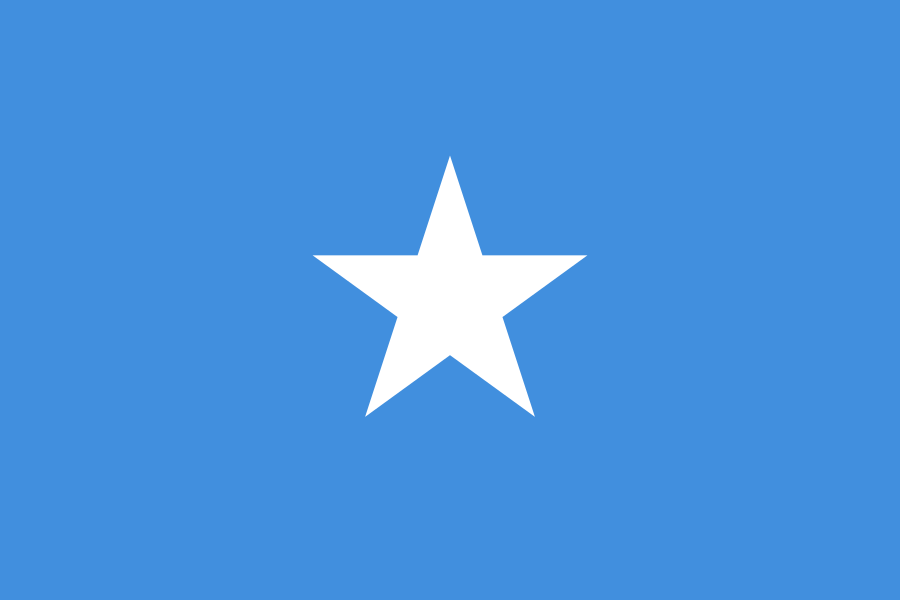
SOMALIA


Have you seen the movie "Black Hawk Down"? It was a story about a group of American special task force end up dying in a God-forsaken country in the remote African desert. America has since relinquished their effort to keep up the presence there. For a country that has never been in peace, the war which just happened last year was just an event as normal as in any other tragic events in this country's history, and its future is as blur as a fading Northen star. The country has been dominated by warlords ever since its independence day. Wrecked havoc by eternally internal conflict and hostile warfares with the biggest neighbor Ethiopia, the country is now awaiting another uprising from the Islamic force after they were driven away by a coalition between Christian-majority Ethiopia and the Interim Somalia Government backed by the US.
" Somalia (Somali: Soomaaliya; Arabic: الصومال transliteration: aṣ-Ṣūmāl), officially the Somali Republic (Somali: Jamhuuriyadda Soomaaliya, Arabic: جمهورية الصومال transliteration: Jumhūriyyat aṣ-Ṣūmāl) and formerly known as the Somali Democratic Republic, is located on the Horn of Africa in East Africa. It is bordered by Djibouti to the north-west, Kenya on its south-west, the Gulf of Aden with Yemen on its north, the Indian Ocean at its east and Ethiopia to the west. The Somali state currently exists solely in a de jure capacity; Somalia has no recognized central government authority nor any other feature associated with an established independent state. De facto authority resides in the hands of the governments for the unrecognized entities of Somaliland and Puntland and the United Nations-recognized, interim Transitional Federal Government (TFG), which until recently controlled only Baidoa. Violence has plagued Mogadishu, the capital, since warlords ousted former President Mohamed Siad Barre in 1991.
Capital
Mogadishu2°02′N 45°21′E
Largest city
Mogadishu
Official languages
Somali
Government
Transitional Federal Government
- President
Abdullahi Yusuf Ahmed
- Prime Minister
Ali Mohammed Ghedi
Independence
from the UK and Italy
- Date
July 1, 1960
Area
- Total
637,657 km² (42nd)246,201 sq mi
- Water (%)
1.6
Population
- 2003 estimate
10,700,000 (74st)
- 1987 census
7,114,431
- Density
13 /km² (198th)34 /sq mi
GDP (PPP)
2006 estimate
- Total
$5.023 billion (160th)
- Per capita
$600 (not ranked)
HDI (2003)
n/a (n/a) (unranked)
Currency
Somali shilling (SOS)
Time zone
EAT (UTC+3)
- Summer (DST)
not observed (UTC+3)
Internet TLD
.so
Calling code
+252
Political organization
In 2002, Southwestern Somalia, comprising Bay, Bakool, Middle Juba, Gedo, Lower Shabelle and Lower Juba provinces of Somalia declared itself autonomous. However, at the time of its declaration, the Rahanweyn Resistance Army, established in 1999, was in full control of Bay and Bakool and parts of Gedo and Middle Juba regions only. This temporary secession was reasserted in 2002, leading to de facto autonomy of Southwestern Somalia. An internal armed conflict between Hasan Muhammad Nur Shatigadud and his two deputies, weakened it militarily. From February 2006, this area and the city of Baidoa became central to the Transitional Federal Government. In 2004, the Transitional Federal Government (TFG) organized and wrote a charter for the governing of the nation. The government wrote the charter in Nairobi. The TFG capital is presently in Baidoa.
In 2006, the Islamic Courts Union rose to predominant control of Somalia. They took over the capital of Mogadishu in the Second Battle of Mogadishu in May–June and began to spread their control through the rest of the country.
Another secession occurred in July 2006 with the declaration of regional autonomy by the state of Jubaland nominally consisting of parts of Gedo, Middle Juba, and the whole of Lower Juba region. Barre Adan Shire Hiiraale, chairman of the Administration of Juba Valley Alliance, who comes from Galgadud region, in central Somalia is the most powerful leader there. This regional government did not want full statehood.
In 2002, Southwestern Somalia, comprising Bay, Bakool, Middle Juba, Gedo, Lower Shabelle and Lower Juba provinces of Somalia declared itself autonomous. However, at the time of its declaration, the Rahanweyn Resistance Army, established in 1999, was in full control of Bay and Bakool and parts of Gedo and Middle Juba regions only. This temporary secession was reasserted in 2002, leading to de facto autonomy of Southwestern Somalia. An internal armed conflict between Hasan Muhammad Nur Shatigadud and his two deputies, weakened it militarily. From February 2006, this area and the city of Baidoa became central to the Transitional Federal Government. In 2004, the Transitional Federal Government (TFG) organized and wrote a charter for the governing of the nation. The government wrote the charter in Nairobi. The TFG capital is presently in Baidoa.
In 2006, the Islamic Courts Union rose to predominant control of Somalia. They took over the capital of Mogadishu in the Second Battle of Mogadishu in May–June and began to spread their control through the rest of the country.
Another secession occurred in July 2006 with the declaration of regional autonomy by the state of Jubaland nominally consisting of parts of Gedo, Middle Juba, and the whole of Lower Juba region. Barre Adan Shire Hiiraale, chairman of the Administration of Juba Valley Alliance, who comes from Galgadud region, in central Somalia is the most powerful leader there. This regional government did not want full statehood.
Languages
Somalia is unique in Africa because all inhabitants speak a native language. Somali is the main language. Somali is used virtually everywhere and nearly every Somali citizen speaks it.
A considerable amount of Somalis speak Arabic due to religious reasons and ties with the Arab world and media. English is also widely used and taught, Italian used to be a major language but due to the civil war and lack of education only the older generation speaks it.
Religion
Eid celebrations in Mogadishu.
The Somalis are Muslims.Loyalty to Islam is what reinforces distinctions that set Somalis apart from their immediate African neighbours, many of whom are either Christians (particularly the Amhara and others of Ethiopia and Kenya) or adherents of indigenous African faiths. "
Somalia is unique in Africa because all inhabitants speak a native language. Somali is the main language. Somali is used virtually everywhere and nearly every Somali citizen speaks it.
A considerable amount of Somalis speak Arabic due to religious reasons and ties with the Arab world and media. English is also widely used and taught, Italian used to be a major language but due to the civil war and lack of education only the older generation speaks it.
Religion
Eid celebrations in Mogadishu.
The Somalis are Muslims.Loyalty to Islam is what reinforces distinctions that set Somalis apart from their immediate African neighbours, many of whom are either Christians (particularly the Amhara and others of Ethiopia and Kenya) or adherents of indigenous African faiths. "
Somalia has long been fighting against Colonialism from the British and the Italian. The two countries pulled Somalia back and forth and even torn it apart during World War II. The independence of the British Somaliland Protectorate from the United Kingdom was proclaimed on 26 June 1960. On 1 July 1960, unification of the British and ex-Italian Somaliland took place. However, after Independence, the country got into a worse shape with more and more territories vied for secession. The main ally of Somalia was the Communist Soviet but the USSR turned against Somalia and supported Ethiopia in the war between the two countries. Inside the country, a conflict to unseat warlords broke out in May 2006. The battle was fought between an alliance of Mogadishu warlords known as the Alliance for the Restoration of Peace and Counter-Terrorism or "ARPCT" and a militia loyal to Islamic Courts Union or "ICU". Outside, Somalia and Ethiopia fought a bitter war in 1977–78 over the Somali province of Ogaden, which has been ruled by the Ethiopians since the partition of Somali lands in the first half of the 20th century by the British Empire. In addition, the ICU claimed that Ethiopia, with its long history as an imperial power, seeks to occupy Somalia, or rule it by proxy.

Tuesday, March 13, 2007
Hypocrisy is in Michael Moore as in any other of his targets
Documentary questions Moore's tactics
By CHRISTY LEMIRE, AP Movie Writer Sun Mar 11, 6:02 PM ET
AUSTIN, Texas - As documentary filmmakers, Debbie Melnyk and Rick Caine looked up to
Michael Moore' name=c1> SEARCHNews News Photos Images Web' name=c3> Michael Moore.
Then they tried to do a documentary of their own about him — and ran into the same sort of resistance Moore himself famously faces in his own films.
The result is "Manufacturing Dissent," which turns the camera on the confrontational documentarian and examines some of his methods. Among their revelations in the movie, which had its world premiere Saturday night at the South by Southwest film festival: That Moore actually did speak with then-General Motors chairman Roger Smith, the evasive subject of his 1989 debut "Roger & Me," but chose to withhold that footage from the final cut.
The husband-and-wife directors spent over two years making the movie, which follows Moore on his college tour promoting 2004's "Fahrenheit 9/11." The film shows Melnyk repeatedly approaching Moore for an interview and being rejected; members of Moore's team also kick the couple out of the audience at one of his speeches, saying they weren't allowed to be shooting there.
At their own premiere Saturday night, the Toronto-based filmmakers expected pro-Moore plants in the audience heckling or trying to otherwise sabotage the screening, but it turned out to be a tame affair.
"It went really well," Melnyk said. "People really liked the film and laughed at the right spots and got the movie and we're really happy about it."
Moore hasn't commented publicly on "Manufacturing Dissent" and Melnyk thinks he never will. He also hasn't responded to several calls and e-mails from The Associated Press.
"There's no point for Michael to respond to the film because then it gives it publicity," she said.
"(President) Bush didn't respond to `Fahrenheit 9/11,' and there's a reason for that," Caine added.
The two were and still are fans of all his movies — including the polarizing "Fahrenheit 9/11," which grossed over $119 million and won the Palme d'Or at the
Cannes Film Festival' name=c1> SEARCHNews News Photos Images Web' name=c3> Cannes Film Festival — and initially wanted to do a biography on him. They traveled to his childhood home of Davison, Mich., visited his high school and traced his early days in politics and journalism.
"The fact that he made documentaries entertaining was extremely influential and got all kinds of people out to see them," said Melnyk, whose previous films with Caine include 1998's "Junket Whore." "Let's face it, he made documentaries popular and that is great for all documentary filmmakers."
"All of these films — `Super Size Me,' `An Inconvenient Truth' — we've all been riding in his wake," said Caine. "There's a nonfiction film revolution going on and we're all beneficiaries of that. For that point alone, he's worth celebrating."
But after four months of unsuccessfully trying to sit down with Moore for an on-camera interview, they realized they needed to approach the subject from a different angle. They began looking at the process Moore employs in his films, and the deeper they dug, the more they began to question him.
The fact that Moore spoke with Smith, including a lengthy question-and-answer exchange during a May 1987 GM shareholders meeting, first was reported in a Premiere magazine article three years later. Transcripts of the discussion had been leaked to the magazine, and a clip of the meeting appeared in "Manufacturing Dissent." Moore also reportedly interviewed Smith on camera in January 1988 at the Waldorf Astoria hotel in New York.
Since then, in the years since "Roger & Me" put Moore on the map, those details seem to have been suppressed and forgotten.
"It was shocking, because to me that was the whole premise of `Roger & Me,'" Melnyk said.
She and Caine also had trouble finding people to talk on camera about Moore, partly because potential interview subjects assumed they were creating a right-wing attack piece; as self-proclaimed left-wingers, they weren't.
Despite what they've learned, the directors still appreciate Moore.
"We're a bit disappointed and disillusioned with Michael," Melnyk said, "but we are still very grateful to him for putting documentaries out there in a major way that people can go to a DVD store and they're right up there alongside dramatic features."
By CHRISTY LEMIRE, AP Movie Writer Sun Mar 11, 6:02 PM ET
AUSTIN, Texas - As documentary filmmakers, Debbie Melnyk and Rick Caine looked up to
Michael Moore' name=c1> SEARCHNews News Photos Images Web' name=c3> Michael Moore.
Then they tried to do a documentary of their own about him — and ran into the same sort of resistance Moore himself famously faces in his own films.
The result is "Manufacturing Dissent," which turns the camera on the confrontational documentarian and examines some of his methods. Among their revelations in the movie, which had its world premiere Saturday night at the South by Southwest film festival: That Moore actually did speak with then-General Motors chairman Roger Smith, the evasive subject of his 1989 debut "Roger & Me," but chose to withhold that footage from the final cut.
The husband-and-wife directors spent over two years making the movie, which follows Moore on his college tour promoting 2004's "Fahrenheit 9/11." The film shows Melnyk repeatedly approaching Moore for an interview and being rejected; members of Moore's team also kick the couple out of the audience at one of his speeches, saying they weren't allowed to be shooting there.
At their own premiere Saturday night, the Toronto-based filmmakers expected pro-Moore plants in the audience heckling or trying to otherwise sabotage the screening, but it turned out to be a tame affair.
"It went really well," Melnyk said. "People really liked the film and laughed at the right spots and got the movie and we're really happy about it."
Moore hasn't commented publicly on "Manufacturing Dissent" and Melnyk thinks he never will. He also hasn't responded to several calls and e-mails from The Associated Press.
"There's no point for Michael to respond to the film because then it gives it publicity," she said.
"(President) Bush didn't respond to `Fahrenheit 9/11,' and there's a reason for that," Caine added.
The two were and still are fans of all his movies — including the polarizing "Fahrenheit 9/11," which grossed over $119 million and won the Palme d'Or at the
Cannes Film Festival' name=c1> SEARCHNews News Photos Images Web' name=c3> Cannes Film Festival — and initially wanted to do a biography on him. They traveled to his childhood home of Davison, Mich., visited his high school and traced his early days in politics and journalism.
"The fact that he made documentaries entertaining was extremely influential and got all kinds of people out to see them," said Melnyk, whose previous films with Caine include 1998's "Junket Whore." "Let's face it, he made documentaries popular and that is great for all documentary filmmakers."
"All of these films — `Super Size Me,' `An Inconvenient Truth' — we've all been riding in his wake," said Caine. "There's a nonfiction film revolution going on and we're all beneficiaries of that. For that point alone, he's worth celebrating."
But after four months of unsuccessfully trying to sit down with Moore for an on-camera interview, they realized they needed to approach the subject from a different angle. They began looking at the process Moore employs in his films, and the deeper they dug, the more they began to question him.
The fact that Moore spoke with Smith, including a lengthy question-and-answer exchange during a May 1987 GM shareholders meeting, first was reported in a Premiere magazine article three years later. Transcripts of the discussion had been leaked to the magazine, and a clip of the meeting appeared in "Manufacturing Dissent." Moore also reportedly interviewed Smith on camera in January 1988 at the Waldorf Astoria hotel in New York.
Since then, in the years since "Roger & Me" put Moore on the map, those details seem to have been suppressed and forgotten.
"It was shocking, because to me that was the whole premise of `Roger & Me,'" Melnyk said.
She and Caine also had trouble finding people to talk on camera about Moore, partly because potential interview subjects assumed they were creating a right-wing attack piece; as self-proclaimed left-wingers, they weren't.
Despite what they've learned, the directors still appreciate Moore.
"We're a bit disappointed and disillusioned with Michael," Melnyk said, "but we are still very grateful to him for putting documentaries out there in a major way that people can go to a DVD store and they're right up there alongside dramatic features."
Subscribe to:
Posts (Atom)